 Add to Chrome
 Add to Firefox
 Add to Edge
EEG Multimodal emotion recognition
Papers and Code
EEG-Based Multimodal Learning via Hyperbolic Mixture-of-Curvature Experts
Apr 14, 2026
Electroencephalography (EEG)-based multimodal learning integrates brain signals with complementary modalities to improve mental state assessment, providing great clinical potential. The effectiveness of such paradigms largely depends on the representation learning on heterogeneous modalities. For EEG-based paradigms, one promising approach is to leverage their hierarchical structures, as recent studies have shown that both EEG and associated modalities (e.g., facial expressions) exhibit hierarchical structures reflecting complex cognitive processes. However, Euclidean embeddings struggle to represent these hierarchical structures due to their flat geometry, while hyperbolic spaces, with their exponential growth property, are naturally suited for them. In this work, we propose EEG-MoCE, a novel hyperbolic mixture-of-curvature experts framework designed for multimodal neurotechnology. EEG-MoCE assigns each modality to an expert in a learnable-curvature hyperbolic space, enabling adaptive modeling of its intrinsic geometry. A curvature-aware fusion strategy then dynamically weights experts, emphasizing modalities with richer hierarchical information. Extensive experiments on benchmark datasets demonstrate that EEG-MoCE achieves state-of-the-art performance, including emotion recognition, sleep staging, and cognitive assessment.

MECO: A Multimodal Dataset for Emotion and Cognitive Understanding in Older Adults
Apr 03, 2026While affective computing has advanced considerably, multimodal emotion prediction in aging populations remains underexplored, largely due to the scarcity of dedicated datasets. Existing multimodal benchmarks predominantly target young, cognitively healthy subjects, neglecting the influence of cognitive decline on emotional expression and physiological responses. To bridge this gap, we present MECO, a Multimodal dataset for Emotion and Cognitive understanding in Older adults. MECO includes 42 participants and provides approximately 38 hours of multimodal signals, yielding 30,592 synchronized samples. To maximize ecological validity, data collection followed standardized protocols within community-based settings. The modalities cover video, audio, electroencephalography (EEG), and electrocardiography (ECG). In addition, the dataset offers comprehensive annotations of emotional and cognitive states, including self-assessed valence, arousal, six basic emotions, and Mini-Mental State Examination cognitive scores. We further establish baseline benchmarks for both emotion and cognitive prediction. MECO serves as a foundational resource for multimodal modeling of affect and cognition in aging populations, facilitating downstream applications such as personalized emotion recognition and early detection of mild cognitive impairment (MCI) in real-world settings. The complete dataset and supplementary materials are available at https://maitrechen.github.io/meco-page/.
E^2-LLM: Bridging Neural Signals and Interpretable Affective Analysis
Jan 11, 2026Emotion recognition from electroencephalography (EEG) signals remains challenging due to high inter-subject variability, limited labeled data, and the lack of interpretable reasoning in existing approaches. While recent multimodal large language models (MLLMs) have advanced emotion analysis, they have not been adapted to handle the unique spatiotemporal characteristics of neural signals. We present E^2-LLM (EEG-to-Emotion Large Language Model), the first MLLM framework for interpretable emotion analysis from EEG. E^2-LLM integrates a pretrained EEG encoder with Qwen-based LLMs through learnable projection layers, employing a multi-stage training pipeline that encompasses emotion-discriminative pretraining, cross-modal alignment, and instruction tuning with chain-of-thought reasoning. We design a comprehensive evaluation protocol covering basic emotion prediction, multi-task reasoning, and zero-shot scenario understanding. Experiments on the dataset across seven emotion categories demonstrate that E^2-LLM achieves excellent performance on emotion classification, with larger variants showing enhanced reliability and superior zero-shot generalization to complex reasoning scenarios. Our work establishes a new paradigm combining physiological signals with LLM reasoning capabilities, showing that model scaling improves both recognition accuracy and interpretable emotional understanding in affective computing.
Multimodal Functional Maximum Correlation for Emotion Recognition
Dec 28, 2025Emotional states manifest as coordinated yet heterogeneous physiological responses across central and autonomic systems, posing a fundamental challenge for multimodal representation learning in affective computing. Learning such joint dynamics is further complicated by the scarcity and subjectivity of affective annotations, which motivates the use of self-supervised learning (SSL). However, most existing SSL approaches rely on pairwise alignment objectives, which are insufficient to characterize dependencies among more than two modalities and fail to capture higher-order interactions arising from coordinated brain and autonomic responses. To address this limitation, we propose Multimodal Functional Maximum Correlation (MFMC), a principled SSL framework that maximizes higher-order multimodal dependence through a Dual Total Correlation (DTC) objective. By deriving a tight sandwich bound and optimizing it using a functional maximum correlation analysis (FMCA) based trace surrogate, MFMC captures joint multimodal interactions directly, without relying on pairwise contrastive losses. Experiments on three public affective computing benchmarks demonstrate that MFMC consistently achieves state-of-the-art or competitive performance under both subject-dependent and subject-independent evaluation protocols, highlighting its robustness to inter-subject variability. In particular, MFMC improves subject-dependent accuracy on CEAP-360VR from 78.9% to 86.8%, and subject-independent accuracy from 27.5% to 33.1% using the EDA signal alone. Moreover, MFMC remains within 0.8 percentage points of the best-performing method on the most challenging EEG subject-independent split of MAHNOB-HCI. Our code is available at https://github.com/DY9910/MFMC.
Cross-domain EEG-based Emotion Recognition with Contrastive Learning
Nov 07, 2025Electroencephalogram (EEG)-based emotion recognition is vital for affective computing but faces challenges in feature utilization and cross-domain generalization. This work introduces EmotionCLIP, which reformulates recognition as an EEG-text matching task within the CLIP framework. A tailored backbone, SST-LegoViT, captures spatial, spectral, and temporal features using multi-scale convolution and Transformer modules. Experiments on SEED and SEED-IV datasets show superior cross-subject accuracies of 88.69% and 73.50%, and cross-time accuracies of 88.46% and 77.54%, outperforming existing models. Results demonstrate the effectiveness of multimodal contrastive learning for robust EEG emotion recognition.
PhysioSync: Temporal and Cross-Modal Contrastive Learning Inspired by Physiological Synchronization for EEG-Based Emotion Recognition
Apr 24, 2025Electroencephalography (EEG) signals provide a promising and involuntary reflection of brain activity related to emotional states, offering significant advantages over behavioral cues like facial expressions. However, EEG signals are often noisy, affected by artifacts, and vary across individuals, complicating emotion recognition. While multimodal approaches have used Peripheral Physiological Signals (PPS) like GSR to complement EEG, they often overlook the dynamic synchronization and consistent semantics between the modalities. Additionally, the temporal dynamics of emotional fluctuations across different time resolutions in PPS remain underexplored. To address these challenges, we propose PhysioSync, a novel pre-training framework leveraging temporal and cross-modal contrastive learning, inspired by physiological synchronization phenomena. PhysioSync incorporates Cross-Modal Consistency Alignment (CM-CA) to model dynamic relationships between EEG and complementary PPS, enabling emotion-related synchronizations across modalities. Besides, it introduces Long- and Short-Term Temporal Contrastive Learning (LS-TCL) to capture emotional synchronization at different temporal resolutions within modalities. After pre-training, cross-resolution and cross-modal features are hierarchically fused and fine-tuned to enhance emotion recognition. Experiments on DEAP and DREAMER datasets demonstrate PhysioSync's advanced performance under uni-modal and cross-modal conditions, highlighting its effectiveness for EEG-centered emotion recognition.
MMME: A Spontaneous Multi-Modal Micro-Expression Dataset Enabling Visual-Physiological Fusion
Jun 12, 2025Micro-expressions (MEs) are subtle, fleeting nonverbal cues that reveal an individual's genuine emotional state. Their analysis has attracted considerable interest due to its promising applications in fields such as healthcare, criminal investigation, and human-computer interaction. However, existing ME research is limited to single visual modality, overlooking the rich emotional information conveyed by other physiological modalities, resulting in ME recognition and spotting performance far below practical application needs. Therefore, exploring the cross-modal association mechanism between ME visual features and physiological signals (PS), and developing a multimodal fusion framework, represents a pivotal step toward advancing ME analysis. This study introduces a novel ME dataset, MMME, which, for the first time, enables synchronized collection of facial action signals (MEs), central nervous system signals (EEG), and peripheral PS (PPG, RSP, SKT, EDA, and ECG). By overcoming the constraints of existing ME corpora, MMME comprises 634 MEs, 2,841 macro-expressions (MaEs), and 2,890 trials of synchronized multimodal PS, establishing a robust foundation for investigating ME neural mechanisms and conducting multimodal fusion-based analyses. Extensive experiments validate the dataset's reliability and provide benchmarks for ME analysis, demonstrating that integrating MEs with PS significantly enhances recognition and spotting performance. To the best of our knowledge, MMME is the most comprehensive ME dataset to date in terms of modality diversity. It provides critical data support for exploring the neural mechanisms of MEs and uncovering the visual-physiological synergistic effects, driving a paradigm shift in ME research from single-modality visual analysis to multimodal fusion. The dataset will be publicly available upon acceptance of this paper.
Towards Robust Multimodal Physiological Foundation Models: Handling Arbitrary Missing Modalities
Apr 28, 2025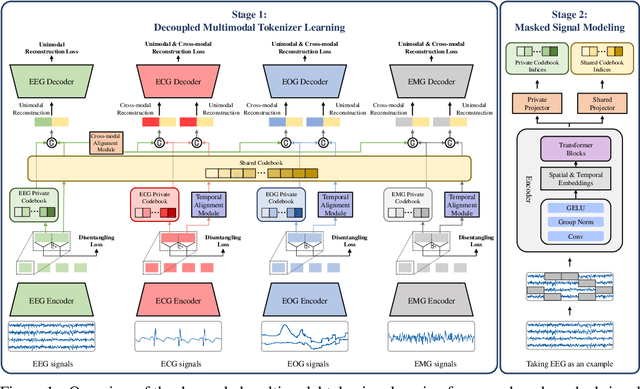

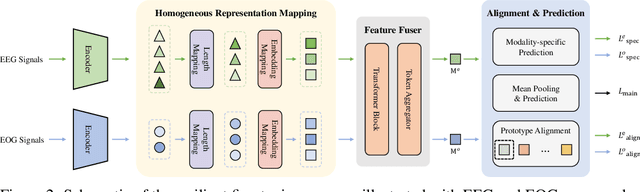
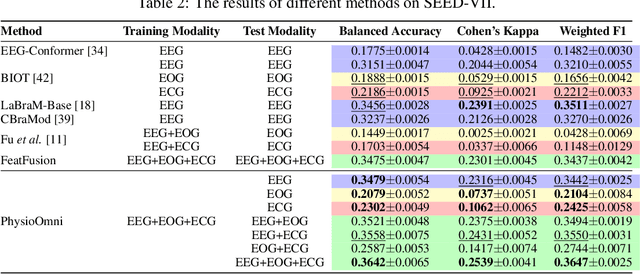
Multimodal physiological signals, such as EEG, ECG, EOG, and EMG, are crucial for healthcare and brain-computer interfaces. While existing methods rely on specialized architectures and dataset-specific fusion strategies, they struggle to learn universal representations that generalize across datasets and handle missing modalities at inference time. To address these issues, we propose PhysioOmni, a foundation model for multimodal physiological signal analysis that models both homogeneous and heterogeneous features to decouple multimodal signals and extract generic representations while maintaining compatibility with arbitrary missing modalities. PhysioOmni trains a decoupled multimodal tokenizer, enabling masked signal pre-training via modality-invariant and modality-specific objectives. To ensure adaptability to diverse and incomplete modality combinations, the pre-trained encoders undergo resilient fine-tuning with prototype alignment on downstream datasets. Extensive experiments on four downstream tasks, emotion recognition, sleep stage classification, motor prediction, and mental workload detection, demonstrate that PhysioOmni achieves state-of-the-art performance while maintaining strong robustness to missing modalities. Our code and model weights will be released.
EEG-based Multimodal Representation Learning for Emotion Recognition
Oct 29, 2024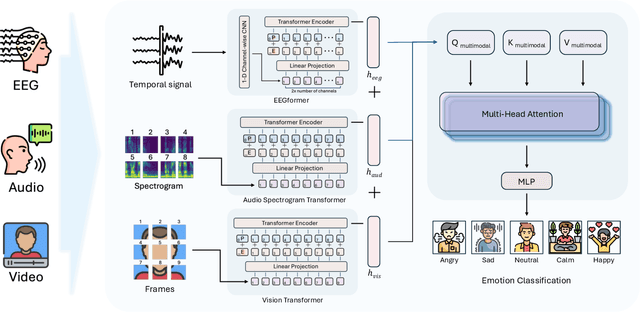
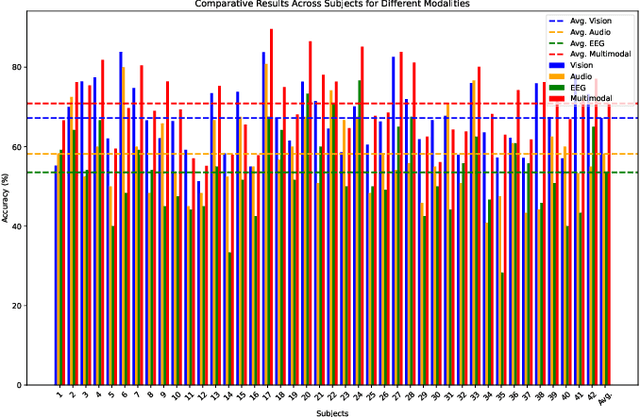
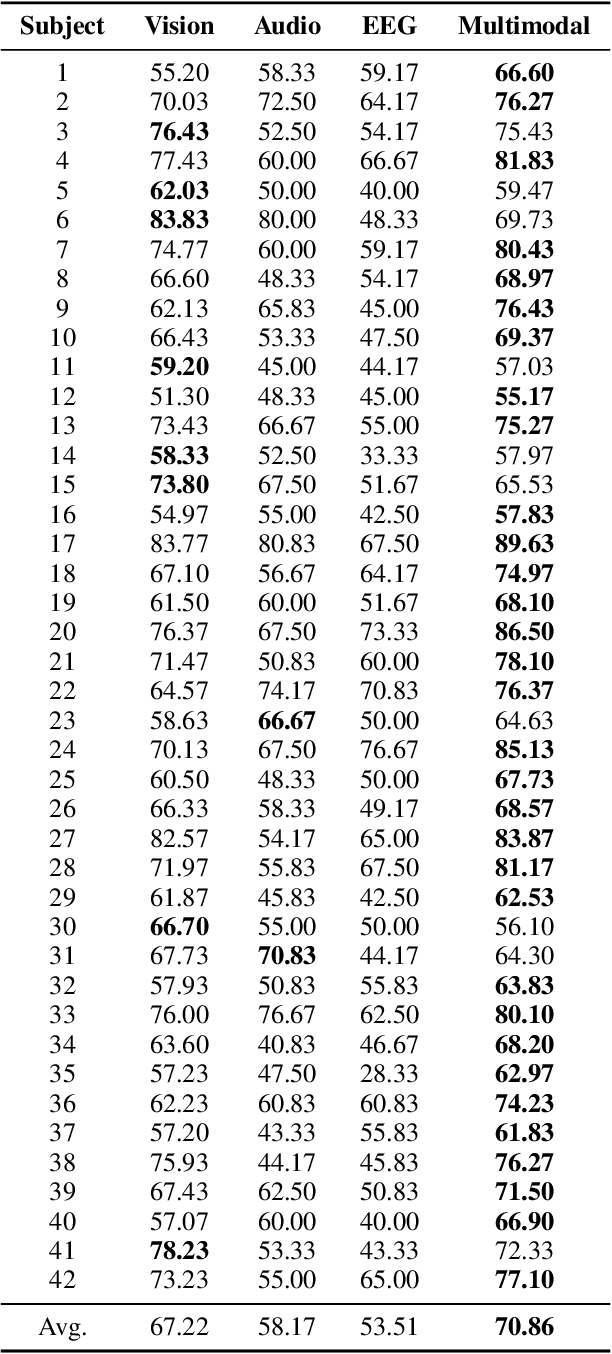
Multimodal learning has been a popular area of research, yet integrating electroencephalogram (EEG) data poses unique challenges due to its inherent variability and limited availability. In this paper, we introduce a novel multimodal framework that accommodates not only conventional modalities such as video, images, and audio, but also incorporates EEG data. Our framework is designed to flexibly handle varying input sizes, while dynamically adjusting attention to account for feature importance across modalities. We evaluate our approach on a recently introduced emotion recognition dataset that combines data from three modalities, making it an ideal testbed for multimodal learning. The experimental results provide a benchmark for the dataset and demonstrate the effectiveness of the proposed framework. This work highlights the potential of integrating EEG into multimodal systems, paving the way for more robust and comprehensive applications in emotion recognition and beyond.
Aesthetic Matters in Music Perception for Image Stylization: A Emotion-driven Music-to-Visual Manipulation
Jan 03, 2025



Emotional information is essential for enhancing human-computer interaction and deepening image understanding. However, while deep learning has advanced image recognition, the intuitive understanding and precise control of emotional expression in images remain challenging. Similarly, music research largely focuses on theoretical aspects, with limited exploration of its emotional dimensions and their integration with visual arts. To address these gaps, we introduce EmoMV, an emotion-driven music-to-visual manipulation method that manipulates images based on musical emotions. EmoMV combines bottom-up processing of music elements-such as pitch and rhythm-with top-down application of these emotions to visual aspects like color and lighting. We evaluate EmoMV using a multi-scale framework that includes image quality metrics, aesthetic assessments, and EEG measurements to capture real-time emotional responses. Our results demonstrate that EmoMV effectively translates music's emotional content into visually compelling images, advancing multimodal emotional integration and opening new avenues for creative industries and interactive technologies.